
One of the most frequently asked questions (fqa) when selling Candy through e-commerce is how to prevent your Candy from being crushed prior to arrival at the customer’s doorstep. Many business owners invest time in selecting excellent products. Business owners select candies based upon taste, label designs, and build strong relationships with customers. After they pack their orders for shipment, if the Candy arrives at the customer’s doorstep as broken, melted, or damaged; all of their effort may be destroyed in a single delivery.
There is one easy way to decrease this problem by selecting the appropriate Candy boxes.
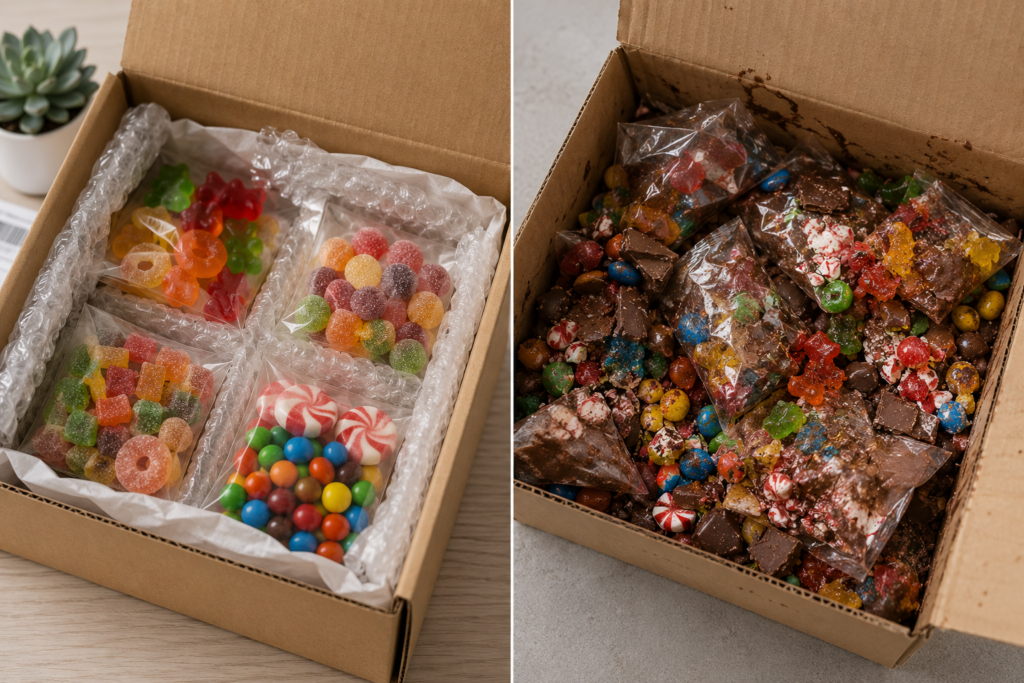
The most frequent error made when selecting a Candy box is to pick a box that is far larger than the Candy contained within. This does not appear to be a significant issue. The Candy is enclosed within the box therefore it will be protected, correct? Incorrect!
If a box is excessively large, merchandise will shift during transportation. Vehicles stop, start, turn, and strike bumps along roads. Each vehicle motion provides opportunities for merchandise to move. The greater the vacant area within the packaging the more room there exists for Candy to move. Movement of Candy products may result in cracks in chocolates, breaks in Candy bars, damages to the packaging materials, and dissatisfied customers.
Instead of using oversized boxes to enclose merchandise, it would be advisable to utilize a box that closely resembles the dimensions of the product being transported. Properly fitting boxes will assist in maintaining products stationary and limiting non-essential movement while transporting merchandise.
Another question frequently posed is whether a heavier duty box offers additional protection. It depends on the type of Candy being shipped. Light weight candies may not require extremely durable packaging however the box used to transport these candies must provide sufficient structural integrity to withstand stacking and typical shipping conditions.
Merchandise is usually stacked on top of other packages in warehouses, on truck beds, and within cargo compartments of delivery vehicles. If a package lacks sufficient structural integrity to support its own weight, it may become bent or collapsed. In addition, even minimal pressure applied to merchandise may cause damage to products within the packaging materials.
Businesses typically focus on storage needs when purchasing boxes. Utilizing identical box sizes for various shipments can simplify shipping procedures and promote organization of inventory. Employees will spend less time searching for materials thereby improving productivity over the course of each working day.

Several businesses have noted that utilizing correctly sized boxes enables them to use fewer fillers. Less filler utilized means shipping areas remain cleaner and shipping supplies will endure longer.
Lastly, customers take notice of packaging. Well fitted packaging usually produces a positive initial impression when an order is delivered. Customers perceive that their product has been properly secured and cared for; thus, establishing credibility with potential repeat buyers.
Selecting Candy boxes seems such a minor task yet it can produce major effects regarding shipping success. Selecting the correct size and strength of a Candy box can significantly aid in protecting products against damage, reducing loss due to damage, and producing a more enjoyable experience for customers from the time their package arrives at their front door.
